Establish the foundations.
A representative process and sample documents. The decisions that require human review. Approved systems, data boundaries and evaluation criteria.
Strategy & discovery ↗Service 06 / Improve
Reduce repetitive work with automation and carefully scoped AI, with people in control of decisions that need judgement.
The commission / an interactive walkthrough
Explore how this service moves from your starting information through a scoped build to testable acceptance and handover.
Your starting material
We start with the users, records, constraints and decisions that the commission must respect.
Share a representative example with private records removed; detailed access follows an agreed secure process.
Specific deliverables, assurance and acceptance depend on the agreed brief.
Explore our delivery process ↗Reduce the repeated work. Keep people in control.
Where it fits
Research, internal knowledge, service triage and document-heavy processes.
What we can deliver
System sketch / Illustrative assisted workflow
Start with a defined event and a narrow task. Establish the expected input, permitted data and intended output.
Illustrative service architecture. Detailed rules and responsibilities are agreed for each commission.
A useful starting point
Acceptance & handover
HandoverWorkflow documentation, evaluation criteria and human review procedures.
From requirements to operation
A representative process and sample documents. The decisions that require human review. Approved systems, data boundaries and evaluation criteria.
Strategy & discovery ↗Implement the agreed scope in reviewable increments. Check user journeys, integration boundaries and failure conditions against the requirements, with unresolved decisions kept visible.
Review the delivery stages ↗Useful results against agreed examples. Exception routing and human review. Failure behaviour, traceability and operating limits.
Workflow documentation, evaluation criteria and human review procedures.
Working examples and archive captures show their stated maturity. The service scope is a commissioning capability, not a claim that every listed system has been deployed for a client.
A related working example
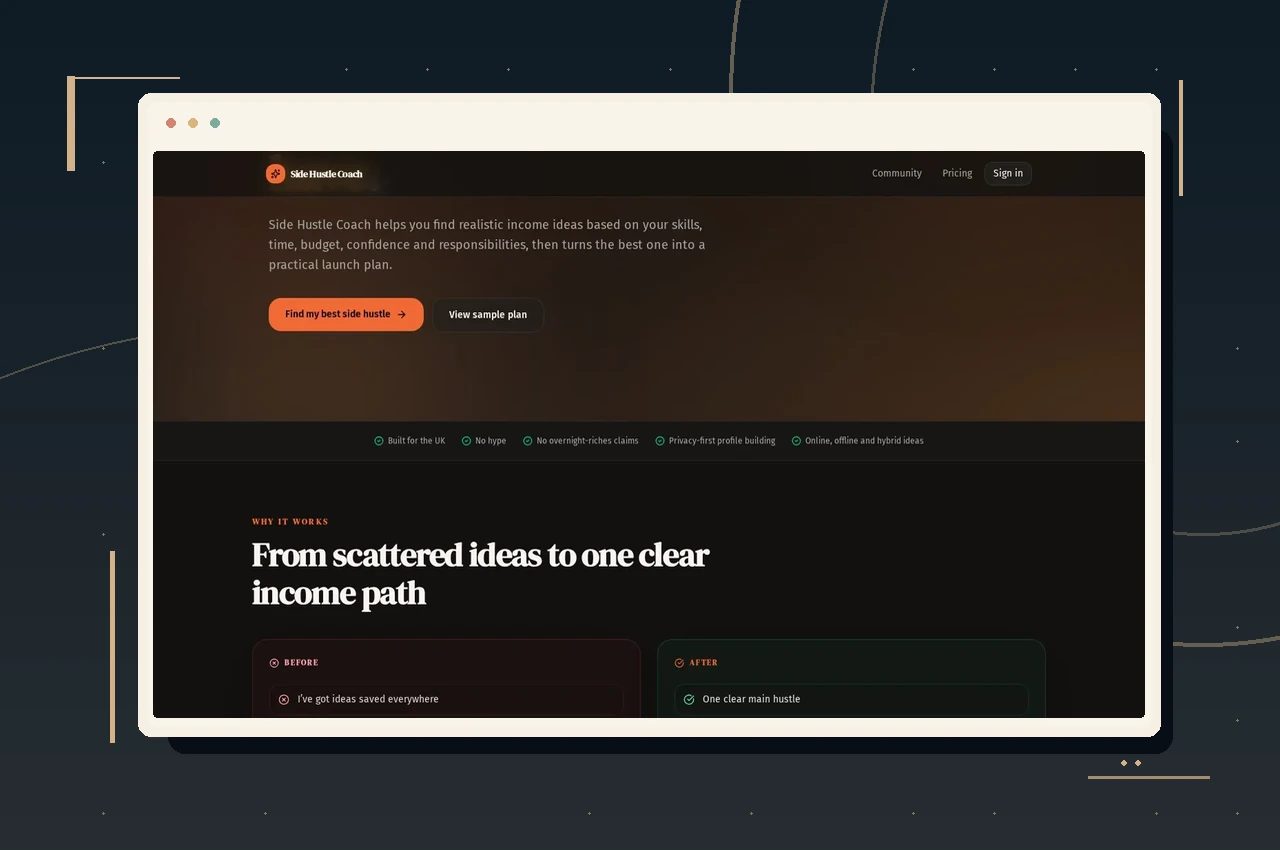
An idea-to-plan product experience connecting coaching, guidance and practical next steps.
Project case study · Archive captures
Explore the project ↗We establish the authoritative sources, mapping rules and access boundaries first. Migration and integration scope includes reconciliation, error handling and recovery responsibilities; production writes and cutover require an agreed review.
Yes, where access and integration are authorised. We first establish ownership, documentation, dependencies and the boundaries of any replacement or connection. A commission does not require abandoning a system that already works.
We prioritise complete user tasks rather than an arbitrary feature count. Scope, exclusions, dependencies and acceptance scenarios are agreed before implementation, with review points for changes.
We identify data owners, information categories and permitted actions during discovery. Controls, retention, specialist assurance and any data-processing responsibilities are scoped against the actual service. A studio credential does not certify your future system.
Documentation, access ownership, training and operating responsibilities are agreed before release. Maintenance, incident coverage and further development have an explicit scope; they are not assumed to be unlimited.
Scope, assumptions, dependencies and changes recorded against the brief.
User journeys, permissions, failure conditions and operating requirements reviewed before release.
Source, documentation, training and recovery responsibilities agreed as part of handover.
Start a conversation
Bring the brief, the source material and the constraints. We will help define the scope and the right next step.