Establish the foundations.
The system, source ownership and deployment inventory. Known issues, release history and operating documentation. Required coverage, escalation and change priorities.
Strategy & discovery ↗Service 12 / Sustain
Keep improving the system after launch with an agreed approach to maintenance, incidents and change.
The commission / an interactive walkthrough
Explore how this service moves from your starting information through a scoped build to testable acceptance and handover.
Your starting material
We start with the users, records, constraints and decisions that the commission must respect.
Share a representative example with private records removed; detailed access follows an agreed secure process.
Specific deliverables, assurance and acceptance depend on the agreed brief.
Explore our delivery process ↗Plan for the life of the system after launch.
Where it fits
Operational platforms, institutional systems and long-term product partnerships.
What we can deliver
System sketch / Illustrative support workflow
Give users and operating teams an agreed route for reporting issues and identifying the affected service.
Illustrative service architecture. Detailed rules and responsibilities are agreed for each commission.
A useful starting point
Acceptance & handover
HandoverAgreed support scope, service levels, escalation contacts and maintenance schedule.
From requirements to operation
The system, source ownership and deployment inventory. Known issues, release history and operating documentation. Required coverage, escalation and change priorities.
Strategy & discovery ↗Implement the agreed scope in reviewable increments. Check user journeys, integration boundaries and failure conditions against the requirements, with unresolved decisions kept visible.
Review the delivery stages ↗Agreed service boundaries and contacts. Monitoring, backup ownership and incident procedures. A maintenance and review schedule appropriate to the system.
Agreed support scope, service levels, escalation contacts and maintenance schedule.
Working examples and archive captures show their stated maturity. The service scope is a commissioning capability, not a claim that every listed system has been deployed for a client.
A related working example
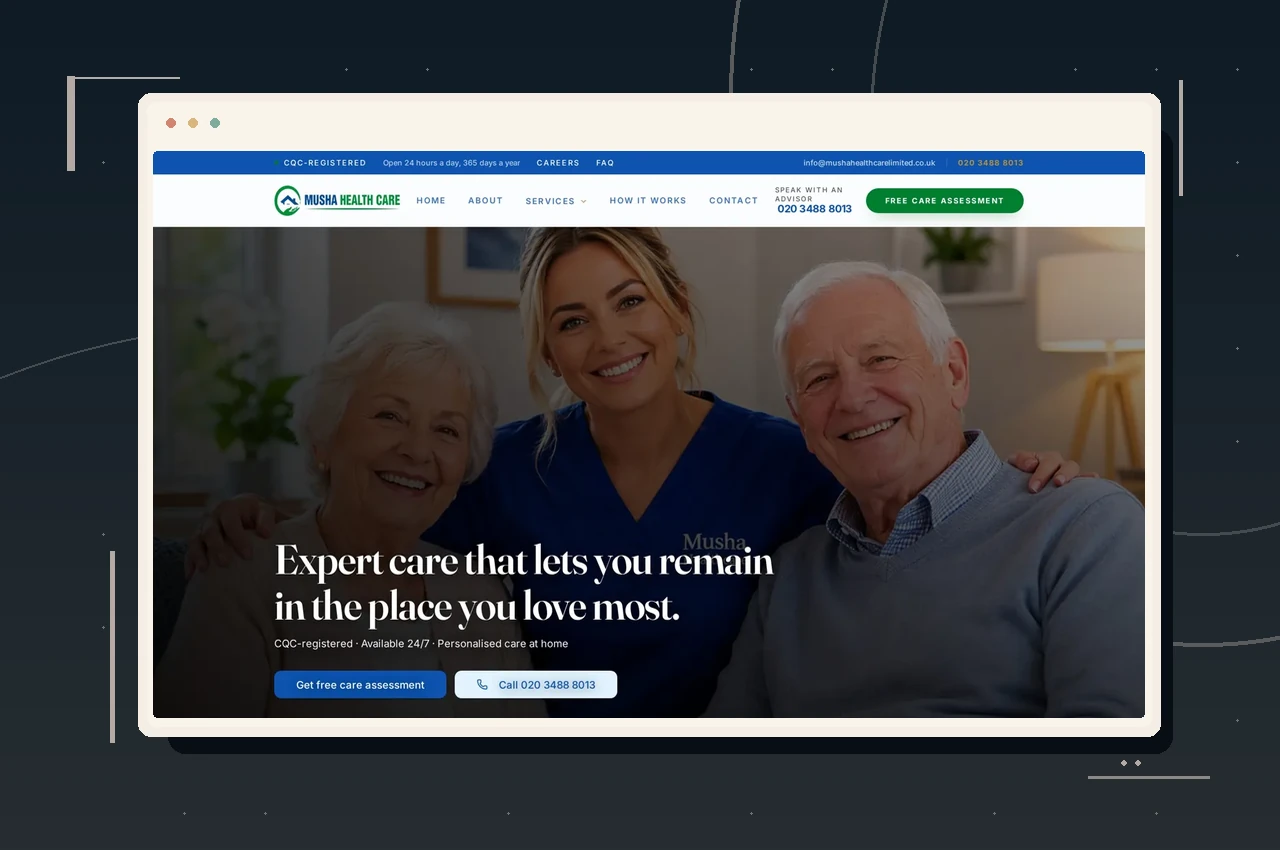
A healthcare website rescue bringing services, recruitment and contact journeys back into view.
Project case study · Archive captures
Explore the project ↗Yes. A defined advisory or review commission can support the existing team. Decision authority, access, recommendations and any ongoing operating or incident responsibilities are agreed explicitly.
Yes, where access and integration are authorised. We first establish ownership, documentation, dependencies and the boundaries of any replacement or connection. A commission does not require abandoning a system that already works.
We prioritise complete user tasks rather than an arbitrary feature count. Scope, exclusions, dependencies and acceptance scenarios are agreed before implementation, with review points for changes.
We identify data owners, information categories and permitted actions during discovery. Controls, retention, specialist assurance and any data-processing responsibilities are scoped against the actual service. A studio credential does not certify your future system.
Documentation, access ownership, training and operating responsibilities are agreed before release. Maintenance, incident coverage and further development have an explicit scope; they are not assumed to be unlimited.
Scope, assumptions, dependencies and changes recorded against the brief.
User journeys, permissions, failure conditions and operating requirements reviewed before release.
Source, documentation, training and recovery responsibilities agreed as part of handover.
Start a conversation
Bring the brief, the source material and the constraints. We will help define the scope and the right next step.