Establish the foundations.
The organisational problem and current process. Stakeholders, constraints and procurement requirements. Existing systems, skills and a target outcome.
Strategy & discovery ↗Service 11 / Deliver
Connect organisational needs to a realistic technical plan, then support the people responsible for adoption.
The commission / an interactive walkthrough
Explore how this service moves from your starting information through a scoped build to testable acceptance and handover.
Your starting material
We start with the users, records, constraints and decisions that the commission must respect.
Share a representative example with private records removed; detailed access follows an agreed secure process.
Specific deliverables, assurance and acceptance depend on the agreed brief.
Explore our delivery process ↗Turn the brief into a practical delivery plan.
Where it fits
Digital transformation, procurement preparation, implementation and service redesign.
What we can deliver
System sketch / Illustrative advisory engagement
Understand the current process, constraints and responsibilities before recommending a change.
Illustrative service architecture. Detailed rules and responsibilities are agreed for each commission.
A useful starting point
Acceptance & handover
HandoverDelivery plan, documentation, training materials and agreed responsibilities.
From requirements to operation
The organisational problem and current process. Stakeholders, constraints and procurement requirements. Existing systems, skills and a target outcome.
Strategy & discovery ↗Implement the agreed scope in reviewable increments. Check user journeys, integration boundaries and failure conditions against the requirements, with unresolved decisions kept visible.
Review the delivery stages ↗Agreed scope, dependencies and responsibilities. Traceable requirements and acceptance criteria. Usable documentation and a knowledge-transfer plan.
Delivery plan, documentation, training materials and agreed responsibilities.
Working examples and archive captures show their stated maturity. The service scope is a commissioning capability, not a claim that every listed system has been deployed for a client.
A related working example
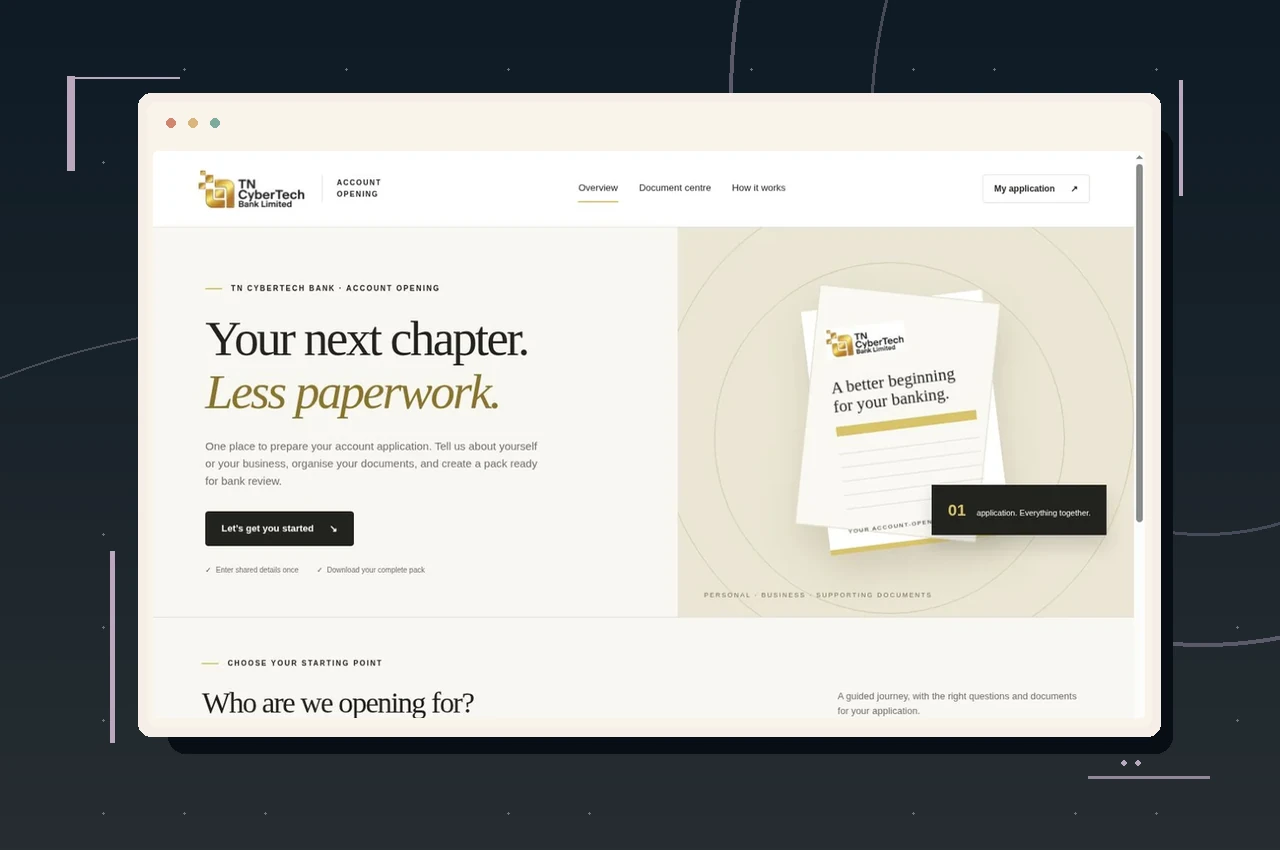
A connected journey for personal and business account documents, shared details and a downloadable application pack. Bank review and activation remain separate.
Working application-preparation portal
Explore the project ↗Yes. A defined advisory or review commission can support the existing team. Decision authority, access, recommendations and any ongoing operating or incident responsibilities are agreed explicitly.
Yes, where access and integration are authorised. We first establish ownership, documentation, dependencies and the boundaries of any replacement or connection. A commission does not require abandoning a system that already works.
We prioritise complete user tasks rather than an arbitrary feature count. Scope, exclusions, dependencies and acceptance scenarios are agreed before implementation, with review points for changes.
We identify data owners, information categories and permitted actions during discovery. Controls, retention, specialist assurance and any data-processing responsibilities are scoped against the actual service. A studio credential does not certify your future system.
Documentation, access ownership, training and operating responsibilities are agreed before release. Maintenance, incident coverage and further development have an explicit scope; they are not assumed to be unlimited.
Scope, assumptions, dependencies and changes recorded against the brief.
User journeys, permissions, failure conditions and operating requirements reviewed before release.
Source, documentation, training and recovery responsibilities agreed as part of handover.
Start a conversation
Bring the brief, the source material and the constraints. We will help define the scope and the right next step.